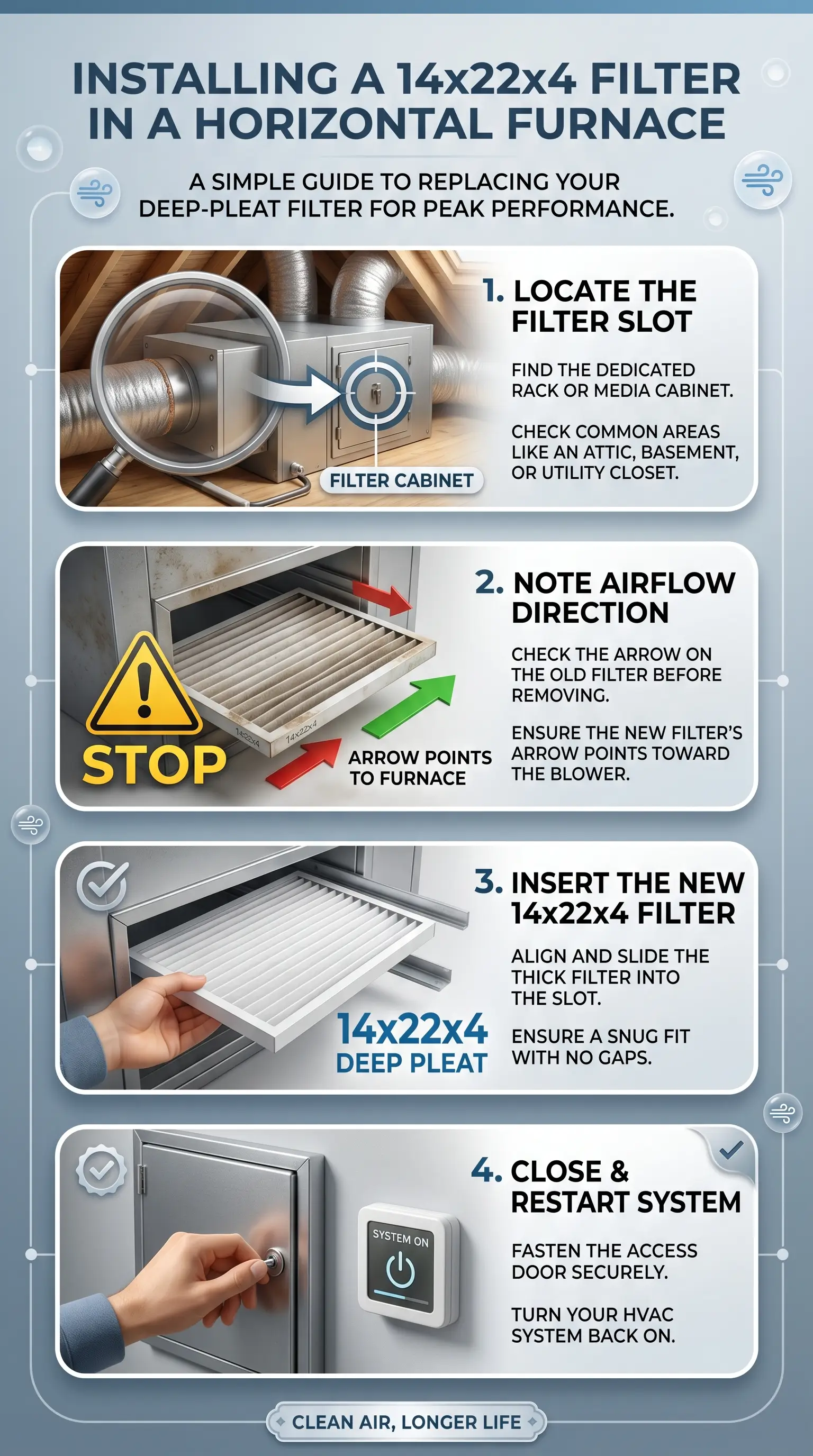
Last June on a Coral Gables service call, I pulled open a horizontal furnace in an attic and found a brand-new 14x22x4 sitting backward in the cabinet. The homeowner bought the right size, picked a solid MERV rating, even dated the frame. He just had the arrow pointing the wrong way. Six weeks into cooling season, his coil was already gray with dust the filter should have caught.
This is the most common install mistake we see on horizontal units across the Coral Gables service area, and the fix takes about 30 seconds once you know what to look for. When you're ready to replace yours, we stock high-quality 14x22x4 air filters in MERV 8 through 13. If you want to pair filtration with whole-home purification, our companion piece on cleaner healthier indoor air walks through how the two work together.
TL;DR Quick Answers
- Arrow direction: toward the blower.
- Filter depth: 4 inches. The cabinet has to match.
- Replacement cadence: every 60 to 90 days in South Florida humidity.
- MERV for most homes: 8 or 11.
- Power off first: always.
- Wet or moldy filter: call a pro before swapping.
Top Takeaways
- Point the arrow at the blower. This is the one detail that breaks most installs.
- Match the cabinet depth. A 4-inch filter belongs in a 4-inch slot. Force it into a 1-inch panel and the media buckles.
- Check the gasket every time. A flat or torn gasket lets unfiltered air slip right past your new filter.
- Power off at both the thermostat and the service switch before you open the cabinet.
- Write the install month on the frame so you remember when to swap.
- Pick the right MERV for your system. For most South Florida homes, MERV 8 or 11 hits the sweet spot. If you aren't sure, understand MERV ratings better before you buy.
- Plan for a 90-day cadence in our climate. Florida humidity loads filters faster than national averages. When you cannot remember the last swap, how often to swap is a quick read.
In a horizontal furnace, the blower pulls return air sideways across the heat exchanger instead of straight up or down. That changes how the filter has to sit. Gasket compression and media sag both behave differently than they do in an upflow cabinet. A 14x22x4 media air filter is four inches deep and tightly pleated, so the dust-holding capacity is excellent. The flip side: a misaligned filter creates more bypass than a thin 1-inch panel ever could. Newer to furnace filtration entirely? This complete filter primer is a solid starting point.
Three install details make or break a horizontal-cabinet swap:
- Airflow arrow: must point at the blower and heat exchanger. Never back at the return duct.
- Gasket orientation: the gasket side faces the air-entering side. Check the printed label on the filter frame.
- Cabinet fit: a 4-inch filter belongs in a 4-inch cabinet. Wedging one into a 1-inch slot will buckle the media and starve the blower.
Get those three right and you have a clean install that performs the way it should.

“In twenty years of HVAC work across South Florida, the single most common service call I get on horizontal furnaces is a filter installed backward. Point that arrow toward the blower, seat the gasket flush, and you've protected your blower motor while pulling cleaner air through the whole house.”
7 Essential Resources
These are the non-commercial sources we send homeowners to when they want to go further:
- EPA, Indoor Air Quality (IAQ) Hub: epa.gov/indoor-air-quality-iaq. The federal starting point on indoor pollutants and ventilation basics.
- U.S. Department of Energy, Air Conditioner Maintenance: energy.gov/energysaver/air-conditioner-maintenance. Official guidance on filter replacement and system upkeep.
- ENERGY STAR, Heating and Cooling: energystar.gov/products/heating_cooling. Efficiency standards and maintenance checklists for furnaces and AC systems.
- ASHRAE, Standards and Technical Resources: ashrae.org/technical-resources. The engineering body behind MERV ratings (Standard 52.2) and ventilation specs.
- CDC, Asthma Data and Resources: cdc.gov/asthma. National data on asthma triggers, including indoor air quality factors.
- American Lung Association, Indoor Air Pollution: lung.org/clean-air/indoor-air. Homeowner-friendly explanations of what's in your air and how to reduce exposure.
- NADCA, National Air Duct Cleaners Association: nadca.com. The starting point when the duct system itself needs attention.
3 Statistics Worth Knowing
- Americans spend roughly 90 percent of their time indoors, and indoor pollutant concentrations often run 2 to 5 times higher than typical outdoor levels. (EPA, Indoor Air Quality Report)
- A clean filter can lower HVAC energy use by 5 to 15 percent, according to the U.S. Department of Energy. That is real money during a South Florida cooling season. (DOE, Energy Saver)
- About 8.6 percent of U.S. adults currently live with asthma, a condition that indoor air pollutants can trigger or worsen. (CDC FastStats, Asthma)
Final Thoughts and Opinion
After enough service calls, the pattern is clear. A 14x22x4 filter is one of the best investments a horizontal-furnace homeowner can make, but only when it goes in correctly. Plenty of homeowners treat the swap as a 30-second chore and assume the job is done once the filter slides into place. It isn't. A four-inch media filter gives you 90 days of life and captures finer particles than a thin panel can, but those benefits disappear the second the arrow points wrong or the cabinet door doesn't seal.
After years of pulling backward filters and bowed cabinets out of Coral Gables attics, our opinion is simple: take the extra minute. Look at the arrow, wipe down the rails, and listen for any whistles once you close the door. If you want another layer of defense against the smaller particles a pleated filter cannot catch, pair with an ionizer. Some homeowners go reusable instead. The best washable choices and reusable filter recommendations articles are worth a read if sustainability matters to you, although most horizontal furnaces still perform best with a dense pleated 4-inch.
Frequently Asked Questions
How often should I change a 14x22x4 filter in a horizontal furnace?
In South Florida, every 60 to 90 days for a MERV 8 or MERV 11. If you have pets, smokers, or anyone in the house with allergies, check it monthly and swap when it looks gray.
Which way does the airflow arrow point?
Always toward the blower and heat exchanger. Never back at the return duct. You'll find the arrow printed on the filter frame.
Can I use a 14x22x4 in any horizontal furnace?
Only if your cabinet was built to hold a 4-inch media filter. Slot depth matters. A 4-inch filter shoved into a 1-inch slot will bow and bypass air around the gasket.
Will a higher MERV give me cleaner air?
Higher MERV captures finer particles, but it also restricts airflow. If your blower cannot push enough air through a MERV 13, you lose efficiency and stress the motor. Match the MERV to your system's capacity. When you are not sure where the line is, ask a technician.
What if my old filter looks wet or moldy?
That points to something bigger than a filter issue, usually condensate intrusion or duct sweating. Don't just swap and forget. Request a service estimate before mold spreads into the ductwork.
Get the Right Filter Heading to Your Door
Pick a filter that fits your cabinet the first time. Filterbuy carries American-made 14x22x4 media filters in MERV 8, MERV 11, and MERV 13, with custom sizing available when your cabinet falls between standards. Set up auto-delivery and your next filter shows up before the current one is overdue.
Need a technician to look at a sweating cabinet or a backward-install job? Our Filterbuy HVAC Solutions team has been working horizontal furnaces across Coral Gables and South Florida for three generations—and we treat your house the way we'd want someone treating ours.
Learn more about HVAC Care from one of our HVAC solutions branches…
Filterbuy HVAC Solutions - Miami FL - Air Conditioning Service
1300 S Miami Ave Apt 4806 Miami FL 33130
(305) 306-5027
https://maps.app.goo.gl/Ci1vrL596LhvXKU79